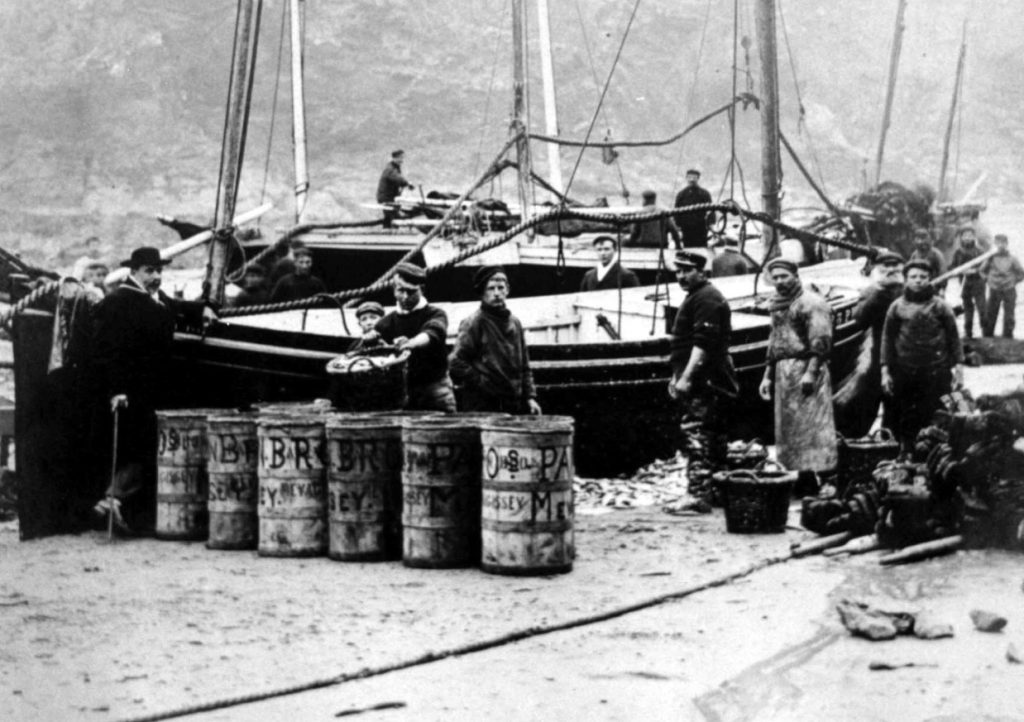
Pawlyn Bros of Mevagissey were among the most significant fish merchants in the Cornish fish trade, operating far beyond a single harbour. Evidence from surviving correspondence and records shows that the firm operated across multiple ports, including Mevagissey, Plymouth, Padstow, and Port Isaac. This network reflects the scale of their involvement in the Cornish fish trade.
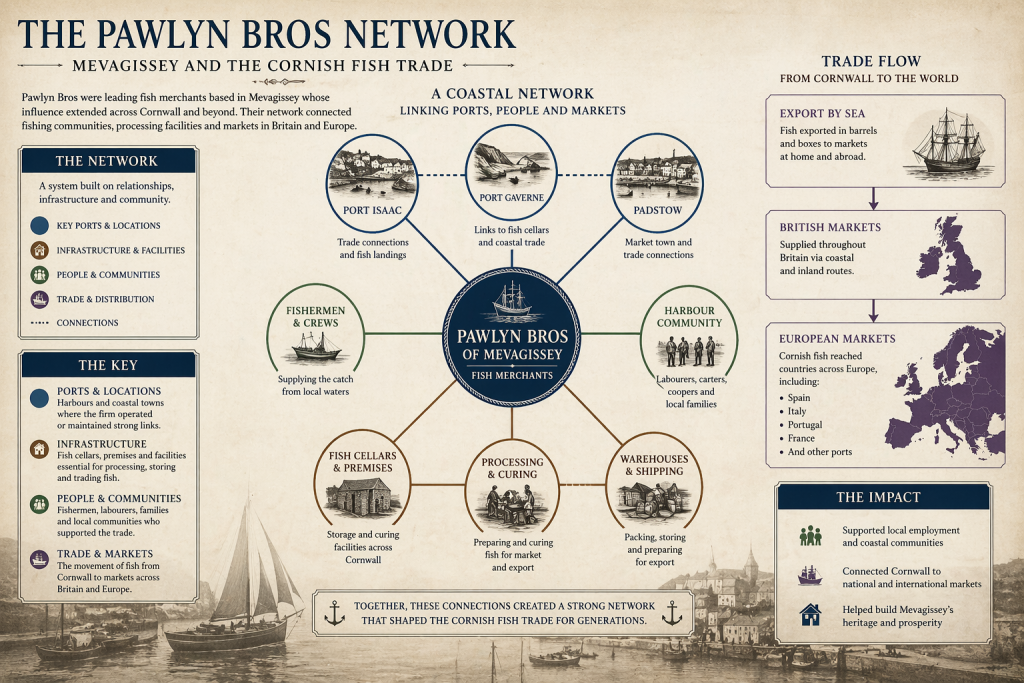
By maintaining connections between these locations, Pawlyn Bros were able to coordinate the movement, processing, and sale of fish beyond the immediate village. Their activities linked local fishing crews with wider commercial markets, both within Britain and overseas.
The firm’s presence across several ports also suggests a level of organisation and capital that set them apart from smaller operators. Rather than working in isolation, they formed part of a broader trading system, helping to structure the flow of goods through Cornwall’s coastal economy.
Pawlyn Bros Within the Harbour Community
In Mevagissey itself, firms such as Pawlyn Bros were central to the working life of the harbour. Their operations relied on, and supported, a wide network of labour:
- Fishermen supplying the catch
- Workers involved in curing and processing
- Carters and traders handling distribution
- Families whose livelihoods depended on the trade
This interconnected system meant that the success or failure of firms like Pawlyn Bros had a direct impact on the wider community. Their role extended beyond commerce, influencing employment, daily routines, and the structure of the village economy.
A Connected Coastal Economy
The activities of Pawlyn Bros illustrate how Mevagissey functioned not as an isolated village, but as part of a wider maritime network. Fish landed in one harbour could be processed in another, sold through different ports, and ultimately exported to distant markets.
Through firms such as Pawlyn Bros, the local and the international became closely linked. The work carried out along the quays of Mevagissey formed part of a much larger system of trade, extending far beyond Cornwall itself.
Family Networks and the Wider Trade
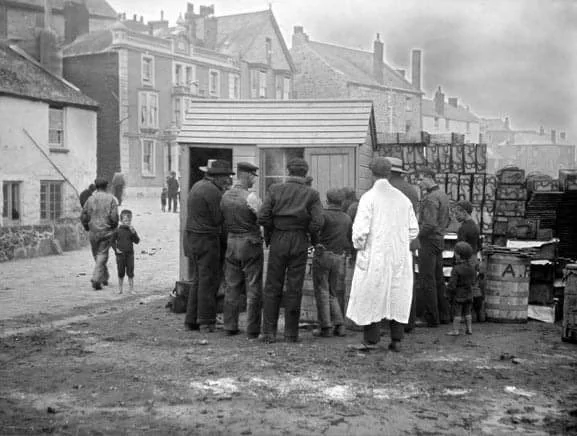
The activities of Pawlyn Bros did not exist in isolation. Like many coastal enterprises in Cornwall, the fish trade was shaped by a network of interconnected families, properties, and local relationships.
Evidence from property records and historical accounts suggests links between trading families operating across different harbours. In places such as Port Gaverne, fish cellars and processing facilities were often held within extended family networks, including those associated with the Harris family. These connections formed part of a wider system through which fish could be landed, cured, stored, and distributed.
Such arrangements were typical of the period. Rather than large, centralised companies, the trade depended on cooperation between merchants, property holders, and fishing crews. Families such as the Pawlyns operated within this structure, maintaining relationships that allowed trade to function across multiple locations.
Fish Cellars and Coastal Infrastructure
The physical infrastructure of the trade – particularly fish cellars – played a crucial role in this network. These buildings were used for curing and storing pilchards before export, and their ownership often reflected deeper family and commercial ties.
In locations such as Port Gaverne, cellars passed between related families over time, illustrating how control of key assets remained within established local groups. The use of these spaces by different operators suggests a shared system of production, rather than isolated businesses.
For firms like Pawlyn Bros, access to such facilities would have been essential. Whether through ownership, lease, or family connection, these sites formed part of the operational backbone of the trade.
A Network of Harbours and Families
Taken together, these relationships point to a broader pattern. Mevagissey, Port Gaverne, Padstow, and other coastal settlements were linked not only by the movement of fish, but by the people and families involved in the trade.
Through these networks, knowledge, labour, and resources could move between locations. This allowed the industry to function on a larger scale than any single harbour could support alone.
Within this system, Pawlyn Bros can be understood not simply as merchants, but as participants in a wider web of economic and family relationships that shaped the Cornish fishing trade.
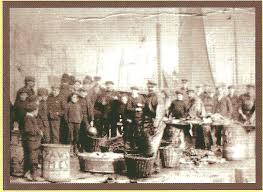
King Edward’ landing fish on Port Isaac beach, circa 1905 to Pawlyn Bros.