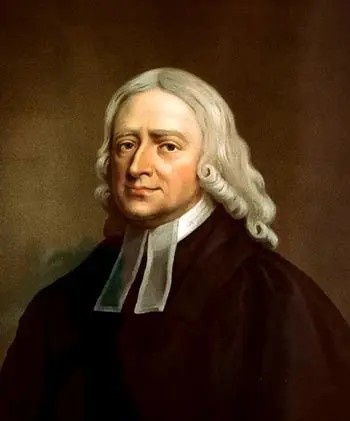
John Wesley (1703-1791), founder of Methodism, travelled extensively through Cornwall, bringing his message to coastal communities such as Mevagissey in the 18th century.
“I rode to Mevagissey, which lies on the south sea”
– John Wesley
A harbour shaped by work, not words
Before it was ever a place to visit, Mevagissey was a place to endure. The harbour was tight and busy, its quays lined with boats, the smell of salt, fish and tar never far from the air.
Life here followed the movement of the sea. When pilchards came, the village surged with activity – nets were cast, cellars filled, and barrels packed for export across the Channel.
When they did not, there was little to fall back on.
This was a community built on labour, risk, and routine – not a place easily stirred by new ideas.
Cornwall in the mid-18th century
By the time John Wesley began travelling through Cornwall, the region was already changing – but unevenly.
Ports were growing. Trade was expanding. But many coastal communities, including Mevagissey, remained relatively isolated, shaped more by necessity than by wider movements of thought.
Religion existed, but often at a distance from daily life. Formal, structured, and not always accessible to those whose lives were dictated by the tide rather than the clock.
Yet ideas like these did not remain in Cornwall alone – they travelled with those who left, taking roots across the Atlantic in what would become Cornish American communities.
Wesley’s approach was different.
He preached outside.
He spoke directly.
And he went where others did not.
Riding into Mevagissey
When Wesley arrived, he recorded it plainly:
“I rode to Mevagissey, which lies on the south sea…”
It is a simple line, but it places the village exactly as it was – exposed to the coast, defined by it.
His arrival would not have gone unnoticed. In a place like Mevagissey, news travelled quickly. A stranger, a preacher, gathering people – it was enough to draw a crowd.
And a crowd came.
A village gathers
Wesley did not preach to a quiet congregation. He spoke to the village itself.
Fishermen, labourers, families – people whose lives were practical and immediate – gathered to hear him. Some out of curiosity, some out of doubt, some simply because something unusual was happening.
He later wrote that nearly the whole population was present.
But what struck him most was not the size of the crowd.
It was the silence.
“…all were still as night.”
In a working harbour, stillness is rare. There is always movement – voices, tools, the sea itself.
For that crowd to fall quiet was not ordinary.
The fishermen in harbour
There was another detail Wesley noticed, one that ties directly to the life of the village.
The weather had kept the boats from going out.
“…all the fishermen… had opportunity of hearing.”
This was not a gathering arranged by design. It was circumstance.
The sea had paused, and because of that, the village was present.
Men who would normally have been offshore were standing on land, listening.
That moment – shaped as much by weather as by intention – brought the working life of Mevagissey directly into contact with Wesley’s message.
Words against a hard life
But listening is not the same as accepting.
Mevagissey was not a place easily changed by words. Its people were shaped by uncertainty, by labour, by the constant negotiation with the sea.
They were not sheltered.
They were not idle.
And they were not quick to trust.
Wesley understood this. He had seen it across Cornwall.
What he brought was not comfort, but discipline. Not ease, but expectation.
And yet, for a moment, they listened.
Doubt in the aftermath
Despite the stillness, Wesley left with uncertainty.
Reflecting on his visit, he asked a question that has endured:
“Can any good be done at Mevagissey?”
It was not dismissal. It was honesty.
He recognised what stood before him – a community rooted in its own ways, not easily turned, not easily persuaded.
If anything was to take hold here, it would not be immediate.
A slower kind of change
And that is exactly how it happened.
Methodism did not transform Mevagissey overnight. There was no sudden shift, no single turning point.
Instead:
- a few listened
- a few returned
- a few carried something forward
Across Cornwall, this pattern repeated itself. Wesley moved on, but the ideas remained, gradually finding their place within communities that changed slowly, if at all.
Mevagissey was no exception.
The harbour continues
When Wesley left, the harbour returned to its rhythm.
Boats were launched. Nets were repaired. The sea resumed its hold over daily life.
Nothing visible had changed.
But something had passed through – briefly, quietly – and left a trace.
A place that does not change easily
Mevagissey has never been a place of sudden transformation.
It absorbs change the same way it meets the sea:
- cautiously
- gradually
- on its own terms
Wesley arrived with urgency. He left with doubt.
And somewhere between the two, something began.
A quiet mark on the village
Today, there is little to mark that moment. No sign, no monument, nothing that announces it.
But it remains part of the deeper fabric of the village – alongside fishing, trade, and the hidden movements that shaped life along this coast.
It is a reminder that even here, in a place defined by work and survival, ideas still arrived.
And sometimes, they stayed.