Introduction
The modern harbour at Mevagissey was not simply built through local effort alone, but formally established through national legislation, shaping what is now the Mevagissey Harbour and the wider history of the village.
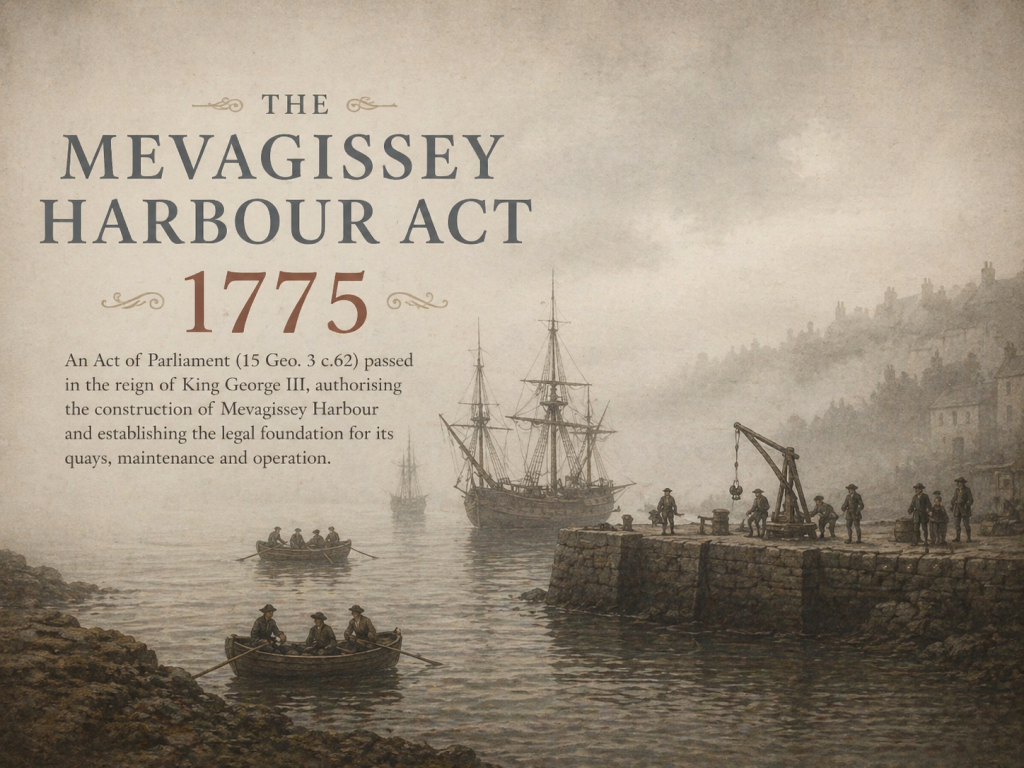
In 1775, an Act of Parliament – commonly referred to as the Mevagissey Pier Act (15 Geo. III c.62) – authorised the construction of the harbour’s original quays and provided the legal framework for its operation.
This marked the transition of Mevagissey from a small coastal settlement into a recognised and structured fishing harbour.
The Act of Parliament
Passed during the reign of King George III, the Act granted powers to construct and maintain harbour infrastructure at Mevagissey.
Its provisions enabled:
- The construction of the East and West Quays
- The improvement of shelter for fishing vessels
- The establishment of a managed harbour space
- The ability to raise funds for construction and upkeep
This was not unusual for the time – many harbours around Britain were formalised through Acts of Parliament – but it placed Mevagissey firmly within that national framework.
While governance today sits across multiple bodies, including the Mevagissey Parish Council, the foundations of authority began with the 1775 Act.
A Statutory Harbour
Because of this legislation, Mevagissey Harbour is not simply a local amenity.
It is a statutory harbour, meaning its existence and operation are rooted in law rather than informal development.
This distinction remains important today, as it shapes how the harbour is governed, maintained, and adapted over time.
Legacy and Long-Term Impact
The 1775 Act laid the foundation for everything that followed:
- The growth of the pilchard fishing industry
- The expansion of harbour infrastructure in the 19th century
- The continued use of the harbour as a working port
What began as a legal framework became the physical and economic centre of Mevagissey.
Relationship to Modern Governance
While the harbour was established through national legislation, it is not directly managed by the parish council.
Today, responsibility for its operation lies with Mevagissey Harbour Trustees (MHT), reflecting a separation between:
- Local governance (Parish Council)
- Harbour management (Trustees)
- Historical legal foundation (Act of Parliament)
This layered structure is key to understanding how the harbour functions today.
Conclusion
The Mevagissey Harbour Act of 1775 represents more than a historical milestone.
It is the legal origin of the harbour itself – a reminder that the village’s identity as a fishing community was shaped not only by the sea, but by decisions made far beyond it.