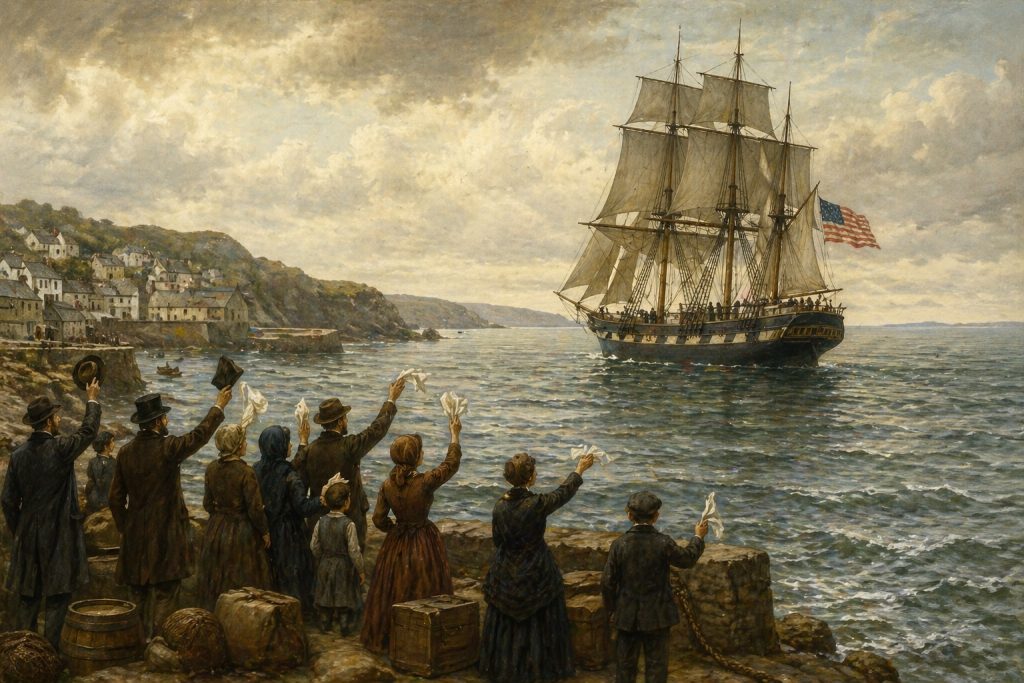
Opening
For generations, people left Cornwall in search of work.
Some went by sea. Others followed the mines.
Many never returned.
Along the south coast, places like Mevagissey were part of that story – communities shaped by fishing, trade, and the need to look outward.
By the 19th century, that outward pull had become a tide. Families left not just for opportunity, but because staying was no longer enough.
Where They Went
In the United States, many Cornish migrants were drawn to places where their skills were needed.
They settled in states such as Michigan, Pennsylvania, Wisconsin, and California, wherever mining or maritime work could be found.
In Michigan’s Upper Peninsula, towns like Calumet and Hancock developed strong Cornish communities. In Pennsylvania, they became part of the mining workforce. In coastal areas, maritime skills carried over into new industries.
The work was different from Cornwall, but familiar in its demands – hard, skilled, and often dangerous.
What They Took With Them
They carried more than tools.
Names, habits, ways of speaking, and ways of working travelled with them.
Recipes, traditions, and small pieces of everyday life crossed the Atlantic, sometimes intact, sometimes altered by distance.
For many, faith travelled too – Methodism, already established in places like Mevagissey through the work of John Wesley, remained a quiet but powerful thread in new communities.
In some places, traces of Cornwall remained visible – in surnames, in food, in the structure of communities.
In others, the connection became quieter, passed down without explanation.
Closing
What remains today is only part of that history.
Some of it was written down. Some of it was carried across the Atlantic. Some of it was left behind.
Many families in the United States still carry Cornish names – names like Trevithick or Polkinghorne, Trelawny, Tonkin or Penrose – often without knowing where they came from or how far the story stretches back.
If your family name has roots in Cornwall, there is a good chance that story began somewhere along this coast – in places like Mevagissey, where life was shaped by the sea, by work, and by the need to look outward.
Not all of those connections were lost.