Mevagissey fishing remains active today, with boats working daily from one of Cornwall’s last traditional fishing harbours.
It is a working fleet shaped by season, weather and the limits of the sea – not by schedules or expectations.
A Working Fishing Harbour
Mevagissey Fishing has never been predictable.
It is not controlled, not guaranteed, and never the same from one day to the next.
Everything depends on conditions – wind, tide, visibility, and what is moving beneath the surface.
That uncertainty defines the work.
Leaving Before Light
Most boats leave before dawn.
Engines start in darkness. Lights move slowly out of the harbour, one by one.
By the time the village wakes, the fleet is already at work.
There is no fixed schedule.
Some days are short. Others stretch long into the afternoon.
It depends on what the sea allows.
What Is Caught
The catch changes throughout the year.
Different species move through Cornish waters with the seasons, and the fishing follows them.
Common landings include:
Sardines (Pilchards)
Mackerel
Crab and lobster
Hake and other white fish
Some days are plentiful. Others are not.
There is no way to force it.
Methods That Endure
Mevagissey fishing methods have evolved, but many principles remain the same.
Nets set carefully and retrieved by hand and machine
Pots lowered and hauled for crab and lobster
Lines worked depending on conditions and target species
Technology has changed parts of the process, but not the fundamentals.
Skill, timing and experience still matter more than anything else.
Risk and Reality
Fishing is not romantic work.
Conditions can change quickly. Equipment fails. Catches don’t always come.
Every decision carries weight — when to go out, when to return, when to wait.
It demands judgement built over time.
This is work that can’t be rushed or controlled.
Landing the Catch
When boats return, Mevagissey harbour becomes active again.
Catches are unloaded, sorted and moved quickly.
Freshness matters – what comes in must be handled properly and without delay.
From there, the fish begins its next journey.
Some is sold immediately.
Some is prepared, preserved, and carried further.
Preserving What the Sea Provides
Fishing has always required a way to extend what is caught.
Not everything can be eaten fresh. Not every catch can be sold immediately.
Preserving fish – through salting, curing, or careful preparation – has long been part of coastal life.
It allows the catch to last beyond the day it was landed.
A Living Tradition
Mevagissey is not a museum of fishing.
It is still active, still working, still dependent on the same forces it always has been.
The boats may change. Equipment may improve.
But the relationship between people and the sea remains the same.
Uncertain. Demanding. Essential.
From Catch to Product in Mevagissey Fishing
What is landed through Mevagissey fishing does not simply disappear into supply chains.
Part of it continues – handled carefully, prepared properly, and preserved in a way that reflects where it came from.
This is what keeps Mevagissey fishing connected to both tradition and demand.
Explore the produce shaped by this fishery and learn more about Mevagissey harbour and the people of Mevagissey who continue this work.
A Long Fishing Heritage
For generations, the harbour was filled with working sail.
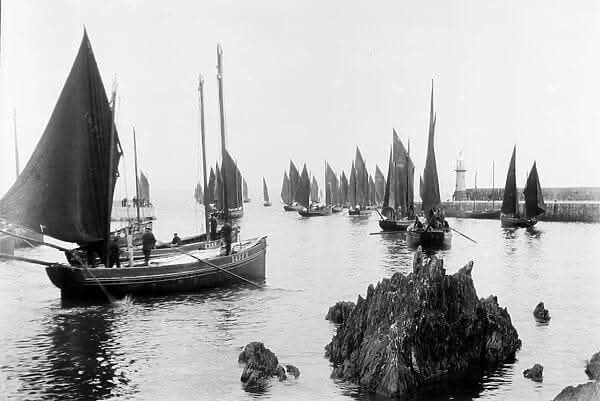
Mevagissey fishing has shaped the village for generations.
Long before tourism, the harbour existed to serve the fishing fleet – landing catches, supporting livelihoods, and connecting the village to the wider coast.
While methods and boats have changed, the purpose remains the same.
Simple tools such as weighted stones, often referred to a milpreves, were used to hold nets beneath the surface.