Little is known of Meva with certainty.
What is recorded is limited.
What is remembered is less clear.
He is counted among those said to have travelled from Ireland and likely Brittany (Armorica) into Cornwall during the early period of the Church, establishing places of instruction along the coast. No contemporary record confirms his origin, and the details that survive are inconsistent.
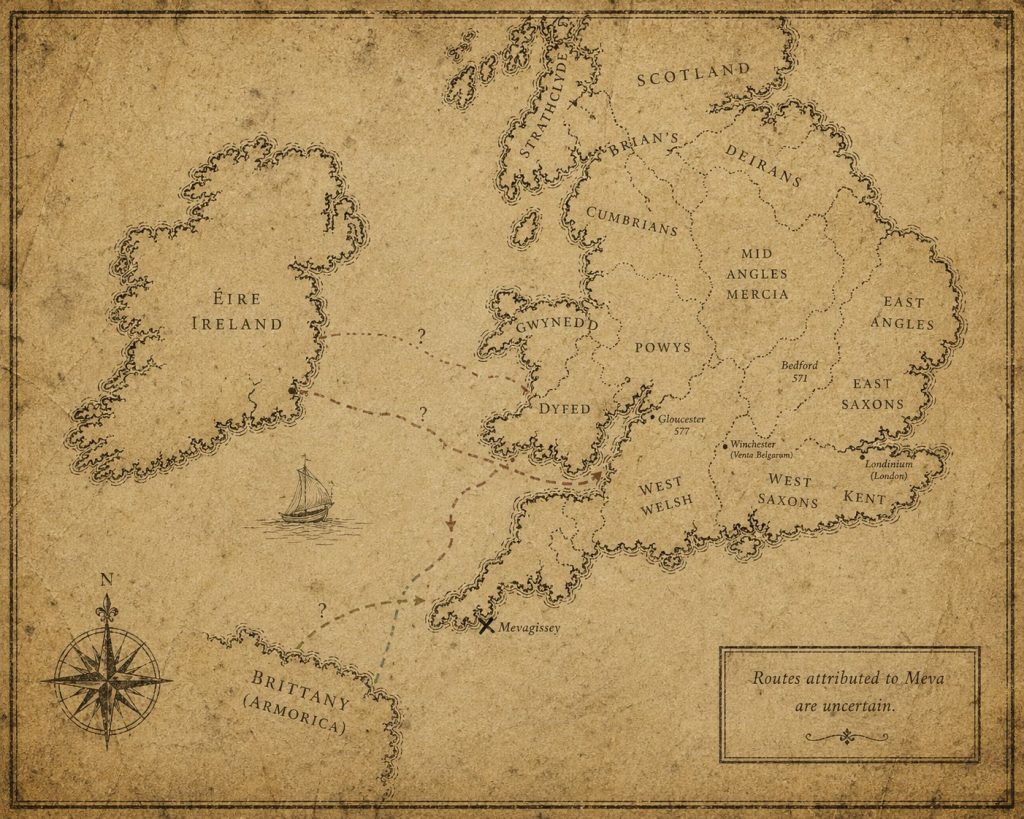
Tradition places him near the harbour, though whether this reflects an original settlement or a later association is not clear. In some accounts he appears as a teacher, moving between communities along the shore. In others, he is described less formally – travelling without fixed dwelling, in the company of fishermen and traders.
The present church at Mevagissey is dedicated not to Meva, but to St Peter.
This is not unusual. Across Cornwall, earlier dedications – often local and only partially recorded – were frequently replaced or absorbed as ecclesiastical structures became more formalised. The process by which one association gave way to another is rarely documented in detail.
As a result, the relationship between the earlier name and the later church remains a matter of interpretation.
Alongside these developments, the harbour supported a mixed and often informal economy. Fishing formed the principal livelihood, but other trade was also present – some of it unrecorded, dependent on tide, opportunity, and discretion.
Later records describe a coastline shaped by movement. Goods were brought ashore where they could be landed, and kept where they would not be found. At times, the movement extended beyond trade. Raiding vessels operated along the coast, taking ships at sea and, on occasion, people from the shore.
The records from these periods are incomplete.
Events are noted. Detail is not always preserved.
Within this wider context, references to Meva become less certain. One later transcription describes him not only as a teacher, but as “a man who dealt in what passed unseen.” The meaning of this phrase is not explained.
A marginal annotation in a different hand contains a single word:
heretic
No date is attached to this addition, and no further context is given. It is not clear whether the term reflects contemporary accusation, later interpretation, or simple error.
Such fragments are not uncommon in the study of early coastal settlements, where the boundary between recorded history and local tradition is often indistinct.
What emerges in the case of Meva is not a fixed account, but a figure shaped over time – part ecclesiastical, part local, and subject to reinterpretation.
The name remains.
The detail does not.